
Blog > Cap Rate and ROI in Waikoloa, HI: Why Your Offer Price Matters Most
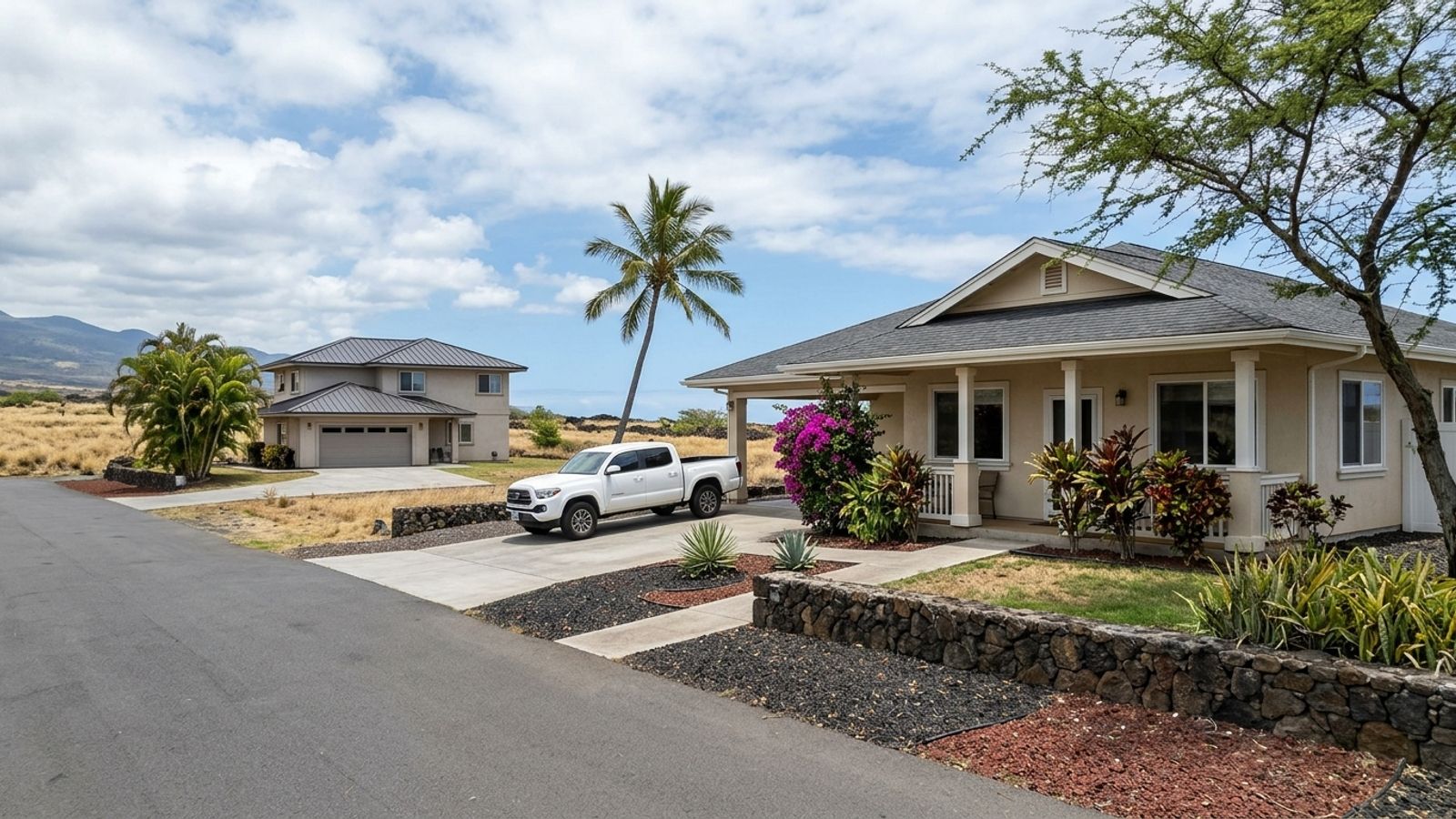
The median sale price for a home in Waikoloa, HI, reached $942,051 recently, a 14.2% increase from a year earlier based on 22 all-home sales, so read it as a snapshot.
Key Takeaway
In Waikoloa, the price you negotiate changes your cap rate more reliably than the rent you project. With 9.9 months of supply across all homes (90 days ending September 30, 2026, based on 22 sales), buyers set the pace of the transaction. Run your cap rate on every listing at a negotiated price rather than the list price. If you plan to finance the purchase, judge the deal on its cash-on-cash return instead.
Who This Guide Is For
You are weighing a Waikoloa rental property and want to work out whether its cap rate and return justify the price before you make an offer.
How Rising Prices Are Changing Waikoloa Cap Rates
In Waikoloa, the purchase price is the cap-rate lever you control. The supply figure in the key takeaway gives buyers room to set terms: homes close at a median 96.9% of list after 85 days on the market. Three factors shape the price side of the trade-off.
What Rising Prices Do to Yield
If rents and expenses hold steady while prices climb at last year's pace, the same property yields about an eighth less than it did a year ago. A 5% cap rate drops to about 4.4%. Public sales data doesn't track local rent increases. Pull current rent comps for the specific property before assuming the squeeze applies, and treat an older seller pro forma or rent roll as stale.
Where Buyers Have Negotiating Room
Bidding wars are rare here. Fewer than one in ten Waikoloa homes sold above asking in the latest 90-day window, so an offer below list is normal, and every point you negotiate off the price lifts your cap rate. These medians cover 22 sales across very different properties, from single-family houses to resort condos. A well-priced listing in a desirable building may not give an inch, so check that property's own days on the market and price history.
Single-Family Homes vs the Rest of the Market
Single-family homes make up about half of Waikoloa's listings but accounted for 18 of the last 22 sales. That gives them deeper resale comps and a faster exit. The slower condo and townhome segment offers more room to negotiate on entry. Its sales were too few to report on their own, leaving no reliable median to value against. Thin comps make both your offer price and your eventual exit harder to defend.
Cap Rate vs ROI for a Waikoloa Rental
Match the formula to how you pay. Cap rate isolates the property's performance, while cash-on-cash return factors in the cost of your debt. These metrics evaluate individual deals; scaling a portfolio requires understanding real estate investing in Waikoloa, HI.
How to Calculate Cap Rate
Cap rate equals your net operating income divided by the purchase price. For a Waikoloa rental, net operating income is gross rent minus:
- vacancy
- Hawaii general excise tax on rent
- county property tax
- insurance
- association dues
- property management
- maintenance and reserves
Mortgage payments are excluded.
In Hawaii, general excise tax applies to rental income, including long-term leases. For 2026, the rate on rental income in Hawaii County is 4.5%, combining a 4.0% state base and a 0.5% county surcharge. Cap rate ignores how you pay for the property and whether it appreciates, so it can't tell you what your own cash earns.
How to Calculate Cash-On-Cash Return
Cash-on-cash return equals your annual pre-tax cash flow after debt service divided by your total cash invested. Cash invested includes your down payment, closing costs and initial repairs. Financed buyers should lead with this metric. Loan type and down payment set your debt service, so settle financing for a rental property before comparing a cash offer against a financed one.
Borrowing cuts your margin of safety. If your mortgage payment exceeds your net operating income, your cash-on-cash return turns negative even when the cap rate looks acceptable. Get a current rate quote from a lender before running this calculation.
Total ROI and Appreciation
Total return on investment adds property appreciation and loan principal paydown to your cash flow. Recent single-family price gains can make total ROI look strong even when the cash yield is thin. Those gains come from one 90-day window covering just 18 single-family sales, so they are a snapshot, not a forecast. Appreciation also stays unrealized until you sell. When you do sell, out-of-state owners face HARPTA withholding at closing, which ties up part of the proceeds until tax filings are complete.
Sample Numbers for a Waikoloa Single-Family Rental
This long-term rental example uses the single-family median sale price to show how a negotiated discount changes the yield. For a nightly rental, both the income and expense lines shift, so compare short-term vs long-term rental net ROI before relying on these figures.
Step 1: Estimate Gross Rent
Find a researched monthly long-term rent for a comparable single-family home, annualize it, and subtract a vacancy allowance (see the vacancy FAQ below). Asking rents on listing sites often run higher than signed leases, and furnished rents differ from unfurnished ones. On any tenant-occupied property, ask for the actual lease or rent roll rather than relying on the seller's estimates.
Step 2: Subtract Operating Expenses
Deduct general excise tax on rent, county property tax at the applicable class rate, insurance, association dues, property management and a maintenance reserve. Management fees vary by company and service level, so ask local property managers for their fee structure. Insurance and dues need real quotes, as explained below.
Step 3: Compare Cap Rate at List and Negotiated Price
For illustration, assume a list price of $1,119,554, which matches the recent single-family median sale price. Closing at the single-family median sale-to-list ratio of 97.2% means paying about $1,088,207, roughly $31,350 less. Because your net operating income doesn't change, this discount is pure yield gain. It raises the cap rate by about 2.9% in relative terms.
That list price is illustrative, and the ratio is a median across only 18 sales. Your actual discount depends on the specific listing's days on the market and the seller's position, and it may be zero.
Step 4: Check Cash-On-Cash with Financing
Take the net operating income from Step 2 and subtract the annual debt service from a lender quote based on your negotiated price. Divide the result by your cash invested. At a high loan-to-value ratio, debt service can quickly exceed operating income on a Waikoloa single-family home. Fixing that usually requires a larger down payment or a lower purchase price, and both change your return.
Expenses That Move a Waikoloa Cap Rate
Nightly rentals also owe transient accommodations tax and need permits under short-term rental zoning and taxes and short-term rental regulations. For any property type, two expense lines need local checks before you offer.
Hawaii County Property Tax
Hawaii County taxes properties by classification, so a rental that isn't the owner's primary residence sits in a different class with a different rate. For the fiscal year beginning July 1, 2026, the Long Term Rental class rate is $7.75 per $1,000 of net taxable value. Residential Tier 1 (up to $2 million) is $11.10. The class can change with the property's use.
The county resets assessed values annually based on market data as of January 1 and mails notices by March 15. Your tax bill, and your cap rate, can therefore drift year to year even if rent stays flat. Check the parcel's current classification and assessed value on the county site before modeling your return.
Insurance and HOA Dues
Insurance and association dues are the two costs most likely to break a pro forma here, and neither can be estimated accurately from public averages. Waikoloa sits on the Hualālai and Mauna Loa lava-flow hazard zone map area, which the USGS divides into nine zones based on the frequency of past inundation. That zoning, combined with hurricane coverage requirements, dictates insurance options and premiums.
Dues come straight out of net operating income. Ask the association for current dues, recent or planned special assessments, and rental rules. Get a written insurance quote, including hurricane coverage, before your inspection deadline.
How to Use These Numbers on a Waikoloa Listing
Start with how you are paying. Cash buyers can lead with cap rate. Financed buyers should lead with cash-on-cash return and the Step 4 check.
If the listing has sat longer than the market's median days on market, run the numbers at a negotiated price, as in Step 3. Use the listing's own days on market and price-change history to set how far below list to offer.
The example uses long-term rent. For a nightly rental, first confirm the parcel is where short-term rentals are allowed and which short-term rental regulations apply. Then base income on Airbnb revenue and occupancy rather than long-term comps, and budget for furnishing and managing a rental.
For single-family versus condo, weigh the deeper resale comps of single-family homes against the association dues that hit condo net operating income hardest.
To run the numbers on a specific listing, contact Travis Lee Scott for a detailed breakdown of local expenses and current market conditions.
At a Glance
- Median sale price: $942,051 (all homes, 90 days ending 2026-09-30, based on 22 sales)
- Median sale price: $1,119,554 (single-family, 90 days ending 2026-09-30, based on 18 sales)
- Year-over-year price change: +14.2% (all homes) and +16% (single-family), 90 days ending 2026-09-30
- Median price per square foot: $630 (all homes) and $658 (single-family), 90 days ending 2026-09-30
- Median days on market: 85 (all homes) and 99 (single-family), 90 days ending 2026-09-30
- Sale-to-list ratio: 96.9% (all homes) and 97.2% (single-family), 90 days ending 2026-09-30
- Share sold above list: 9.1% (all homes) and 5.6% (single-family), 90 days ending 2026-09-30
- Months of supply: 9.9 (all homes) and 6.5 (single-family), 90 days ending 2026-09-30
- Active inventory: 72 (all homes) and 38 (single-family), 90 days ending 2026-09-30
- Caution: all figures rest on 22 all-home sales and 18 single-family sales. Small samples swing quarter to quarter.
Waikoloa Cap Rate and ROI FAQs
Is the Cap Rate the Same as ROI?
No. Cap rate measures the property's income against its price and leaves financing out. ROI measures the return on your own cash and can include borrowing, principal paydown and appreciation. Two buyers of the same Waikoloa home share one cap rate but can have very different ROIs depending on their down payment.
Does Cap Rate Include Mortgage Payments?
No. Debt service is excluded from net operating income by definition, which is why a cap rate can compare cash and financed purchases side by side. Financed buyers should calculate cash-on-cash return to see how their mortgage affects yield.
What Is a Good Cap Rate in Waikoloa?
There's no official local benchmark. A solid rate depends on your financing costs and alternative investments, measured with the property's actual rent and quoted expenses.
What Is the 7% Rule in Real Estate, and Does It Work in Waikoloa?
The 7% rule is an investor screening guideline suggesting a rental property's annual gross income should be at least seven percent of its purchase price to merit further analysis. At the all-homes median sale price, that threshold is about $65,944 a year, or roughly $5,495 a month in rent. Compare current long-term rent comps against it.
Are Waikoloa Home Prices Dropping?
Not in the latest data. The single-family median sale price rose 16% year over year in the 90 days ending September 30, 2026, based on 18 sales. That is a small sample from a single window.
Does a Cap Rate Increase over Time?
It moves whenever your net operating income or the property's value changes. Rent increases raise it, while rising expenses or a higher property value lower it. The county's annual reassessment can also shift your property tax, and with it your net operating income, even when rent stays flat.
What Vacancy Rate Should I Use for a Waikoloa Long-Term Rental?
Start with Census rental vacancy rates for Hawaii County, then add turnover time between tenants, since Waikoloa may differ from the county rate. A local property manager's days-vacant history on comparable homes gives the most accurate estimate.
Sources
Leave a Reply

Agent RS 83053